
Share Family
Linked Data Environment
Linked Data Ecosystem
Technology at the service of the community
System Components
Workflow Components
Key Attributes
Advantages
Are you interested?
Linked Data Ecosystem
The Share Family ecosystem comprises several collaborative LOD - Linked Open Data environments:
- Share-VDE (Virtual Discovery Environment);
- Share-Catalogue - the Italian network of university libraries;
- the PCC data pool - the Program for Cooperative Cataloging (PCC) Catalogue in Linked Data;
- National Bibliographies in Linked Open Data;
- Parsifal - the LOD portal of the URBE consortium (Roman Union of Ecclesiastical Libraries);
- LILLIT: portal for Italian illustrated books 1501-1800;
- BDIB: portal for the Bibliographic Database of Interactive Books - adheres to CC0;
- Kubikat-LOD pilot project - the LOD portal for the catalogues of Kubikat Art History libraries;
- three pilot projects Share-Art, Share-Music, Share-MIA (Manuscripts, Incunabula, Ancient books) respectively in the Art, Music and Ancient book domains.
The different characteristics of each field are a useful asset that can be used to the advantage not only of the Share Family as a whole, but for each single discipline.
Being part of the Share Family linked data ecosystem means facilitating cataloguing and exposition of bibliographic records in linked data, thus supporting the transition from the traditional cataloguing environment to innovative models applying the linked data paradigm, and providing the LAM - Libraries, Archives, Museums domain and information professionals with a more comprehensive suite of tools at their disposal.
The platform and the other dedicated environments part of the Share Family enhance the discovery potential of library resources and unveil information that would otherwise have been hidden in archives, thus enabling the access to a rich amount of data that can be exported and re-imported by the participating institutions.
The output common to all the branches of the Share Family foresees:
- the enrichment of original MARC data and of the records converted in linked data with identifiers from external sources (e.g. ISNI, VIAF) and original Share identifiers;
- the reconciliation and clusterization of entities;
- the indexing of records in the Cluster Knowledge Base, authoritative environment in linked data;
- the conversion of library catalogues from MARC to linked data;• delivery of converted and enriched data to libraries for reuse in their systems;
- the publication of library records in linked data on the relative Share discovery platform.
Technology at the service of the community
The distinctive value of Share Family lies not only in technological innovation, but in the strength of collaboration between project partners and the community of libraries, archives and museums.
A model genuinely oriented towards users: tools and services are developed from the real needs of those who use them, thanks to the active contribution of an international network of national libraries, research institutions and leading bibliographic agencies.
System Components
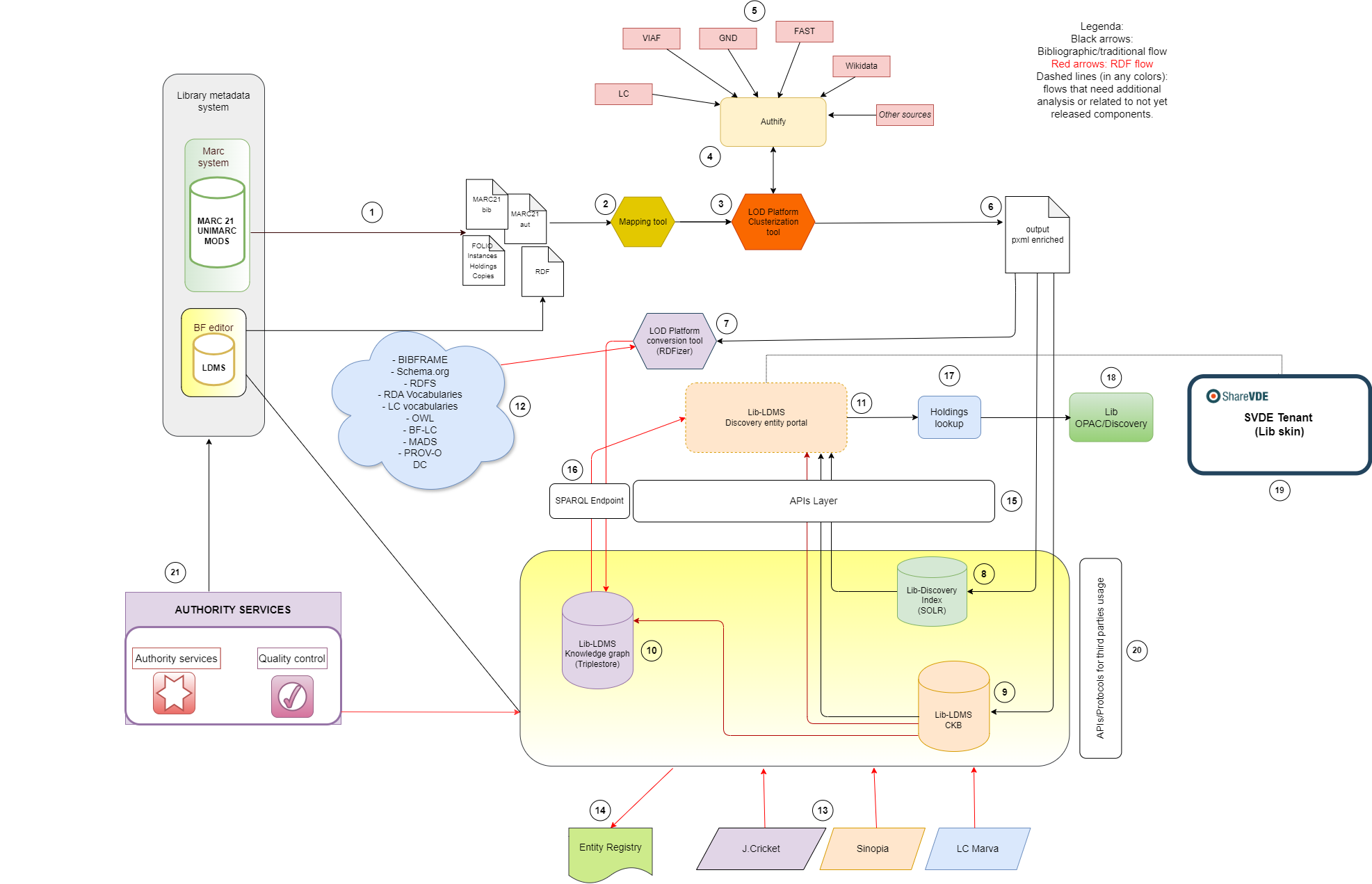
Referring to the Wiki page The LOD Platform Technology for a full and detailed analysis, below is an overview of the platform’s main components.
- Cluster Knowledge Base (Entity Knowledge Base), a collaborative and authoritative infrastructure for the management of high-quality bibliographic and authority data, published in Linked Open Data format
- Multi-level portal for entity search, a system configurable for individual institutions, consortia, or networks of consortia, designed to support complex and distributed research needs
- JCricket Entity Editor, an environment dedicated to shared cataloguing, enabling the collaborative creation and maintenance of linked data entities stored in the Cluster Knowledge Base
- API Layer, an application interface that ensures smooth and scalable integration with external systems
- SPARQL Endpoint and Linked Data Fragments (LDF); the descriptions of linked data are published and queryable via SPARQL endpoints. The implementation of Linked Data Fragments enables a distributed and scalable model for data publication and consumption, through dynamic RDF generation, on-demand ontological mapping, and multi-source management.
Workflow Components
For a detailed description of the stages of acquisition, transformation, and publication of records in Linked Open Data format, please refer to the wiki page LOD Platform workflow components
Integration with third‑party systems for interoperability with ILS/LSPs (e.g., FOLIO, Alma), BIBFRAME editors (e.g., Sinopia, Marva), and authority sources (e.g., Wikidata, ISNI, QA).
Key Attributes
Cooperative: all Share Family members are involved in shaping the tools we use
Sustainable: by working together as a community we are able to share time, expertise and resources we invest across the Share Family for the benefit of all members
Open: we use the BIBFRAME data model and facilitate integration with other ontologies and data fools to support the sharing and cooperative management of resource descriptions in linked data across multiple environments
Inclusive: the Share Family and tools support all languages alphabets and writing systems to include names in their original form and enable the coexistence of resource descriptions that define the same item from diverse point of view
Dynamic: we connect the catalogs of libraries with similar profiles, domains, and disciplines to better accommodate distinct systems, habits, and cataloging traditions. Variations cater to individual requirements, enabling members to define their own involvement and experience
Advantages
Facility in adopting innovative tools
Family represents the will to grow and improve together, integrating comments and requests from users in every phase of development; this confers to the tools a unique and exceptional added value: familiarity, that facilitates learning and use
Higher quality of services
Designed both to assist organizations of any size and type in offering a new, richer, and more interconnected world of information, and to help end users navigate through it
Are you interested?
For us, relationships between people matter even more than those between data
Becoming part of the global Share Family of libraries, museums and archives means embracing the opportunity to be involved in a growing international community, creating dialogue, participation and partnership.
By working together, Share Family member institutions and consortia organizations are actively involved in shaping the future of the emerging ecosystem of bibliographic data in linked data, facilitating the re-use of enriched and structured data and serving the research community with a new generation tool to access knowledge.
Contact us to find out more about the opportunities, options and advantages available and to get involved: info@svde.org